

Pay Attention
An Invitation

Do you spend more time than you would like scrolling or looking at a screen? Have you noticed that your attention span is shorter than it used to be?
Me too!
We live in a world that is constantly competing for our attention. Attention has become one of the most valuable forms of currency—and technology companies have become very skilled at capturing it.
I give my attention away to my phone and to other forms of technology - I pay this attention to these companies and they profit from it. And in the meantime, I spend precious moments of my life giving my attention to something that gives very little back to me. In recent months, I have become increasingly concerned about the impact that is having on me and on all of us.
As I was thinking about this recently, one of Jesus’ sayings from scripture came to mind:
“Where your treasure is, there your heart will be also.”
In light of the way our attention is being monetized in today’s world, I think we could also hear this scripture this way:
Where your attention is, there your heart will be also.
Because what we pay attention to is, in fact, a matter of the heart and of the spirit.
Attention is how we learn to love. We notice what matters to us, and over time we come to care for what we notice. Few people understood this better than the poet Mary Oliver, whose work was shaped by a lifelong habit of attentive presence to the natural world.
She moved slowly. She observed carefully. She paid attention to details that are easy to miss but so precious to behold:
A bird taking flight.
A bumblebee disappearing into a flower.
Light filtering through the trees.
The cool evening air brushing against her skin.
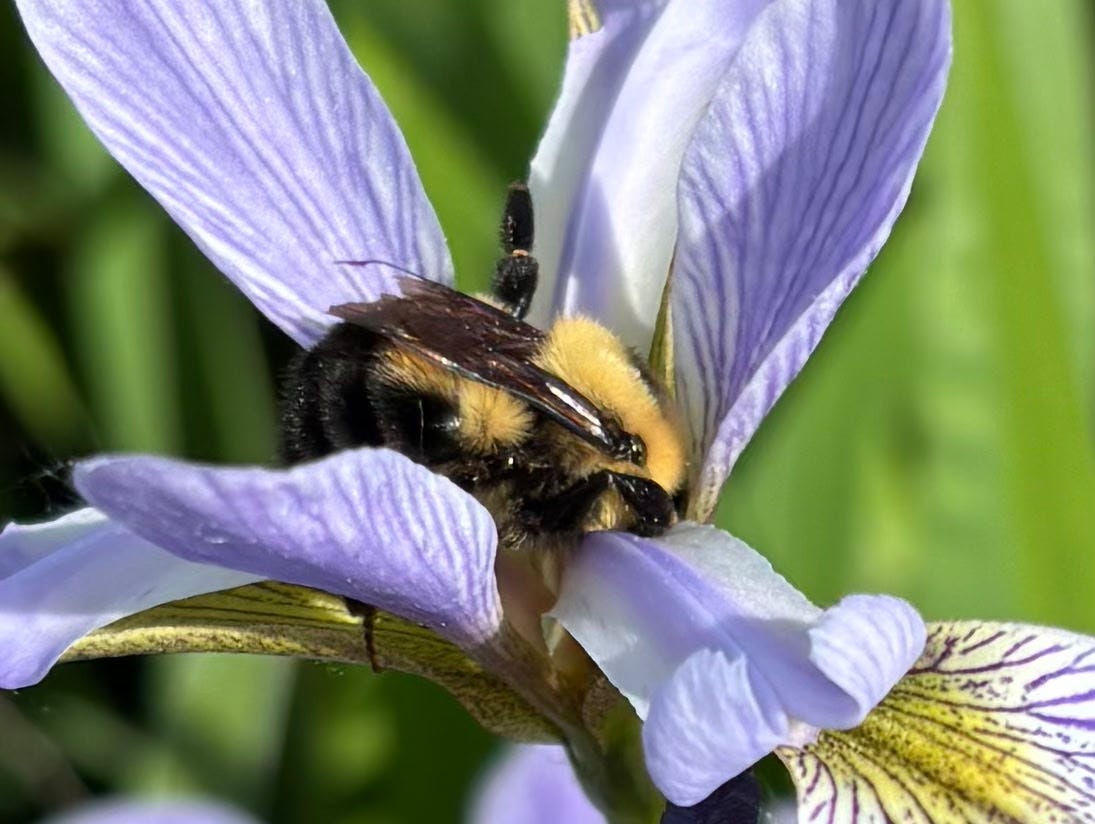
For Oliver, paying attention was not a distraction from life. It was life. And her poetry is filled with stunning observations about the natural world that can only be made by someone with a keen and patient eye and an open heart and mind to what is unfolding before her eyes.
In my opinion, one of the best examples of how Mary Oliver paid attention to the natural world is her poem titled “The Summer Day”. When I read this poem, I can almost see Mary Oliver sitting completely still in a meadow for hours - maybe for multiple hours attending to all the magical things going on around her as she wondered about the world.
The Summer Day by Mary Oliver

Who made the world?
Who made the swan, and the black bear?
Who made the grasshopper?
This grasshopper, I mean--
the one who has flung herself out of the grass,
the one who is eating sugar out of my hand,
who is moving her jaws back and forth instead of up and down--
who is gazing around with her enormous and complicated eyes.
Now she lifts her pale forearms and thoroughly washes her face.
Now she snaps her wings open, and floats away.
I don't know exactly what a prayer is.
I do know how to pay attention, how to fall down
into the grass, how to kneel in the grass,
how to be idle and blessed, how to stroll through the fields,
which is what I have been doing all day.
Tell me, what else should I have done?
Doesn't everything die at last, and too soon?
Tell me, what is it you plan to do
With your one wild and precious life?
“I don’t know exactly what a prayer is. I do know how to pay attention.”
That line is the crux of the poem to me. Prayer is indeed a mystery that begins when we start paying attention to something, someone other than ourselves. When we decide to pray, we marshal our brain, our body, our heart, our words, and become available—to wonder, to gratitude, and to all that is sacred and holy. Prayer IS attention.
Poets like Mary Oliver teach us something important: paying attention leads us somewhere. It can lead us into distraction and endless scrolling. Or it can lead us toward awe, gratitude, and humility.
What we attend to shapes where our lives take root. And when we pay attention to this precious world, we begin to notice something more. We begin to sense that we are not alone. That there is a presence woven through it all—a presence of love and care worthy of our hearts and our attention.
When we pay attention—to the world and to one another—the world itself becomes a kind of sanctuary. Creation becomes a teacher. Every bird, every blossom, every breeze, every interaction becomes an invitation to notice the One who gives life to all things.
But this kind of attention doesn’t just happen. It has to be practiced. To receive these gifts, we have to slow down and be still. We have to gently set aside the things that pull us away and return to what is right in front of us… to this moment, unfolding here and now.
If you, like me, are concerned about how and where you are “paying” your attention, I invite you into a very simple practice. For at least a few minutes each day or multiple times each day. Stop whatever you are doing, set a timer for 1-5 minutes and practice paying attention. Cultivate the habit of looking, listening, and sensing what is happening around you. You can do this in a busy coffee shop, your favorite outdoor spot, a cozy chair in your home, or anywhere you find yourself in the moment it occurs to you to give this a try. And when your mind wanders—as minds do—simply return to noticing. And if you’d like, share what you notice in the comments.
I leave you with these words from Mary Oliver’s poem “Sometimes” In this poem she writes:
“Instructions for living a life:
Pay attention
Be astonished
Tell about it”
May your efforts to pay attention bring astonishment and nourish your heart.
Until next time,
Tisha
Photo Credit: Mary Penninga taken at Zwingli UCC in Mount Vernon